July 23, 2026
The Answer Came First: How Miami and Suntex Scripted the Virginia Key “Fair Market” Appraisals
Public records show the City’s real estate director told the appraisers the expected conclusion before their work was done — while the developer supplied the market data, dictated a key revenue assumption, and reviewed the draft reports before they were finalized.
On November 3, City of Miami voters will be asked to approve leasing more than 27 acres of public waterfront — the Rickenbacker and Marine Stadium marinas on Virginia Key — to Virginia Key LLC, a venture of Dallas-based Suntex Marinas and RCI Marine Group, for 45 years, with renewal options stretching to 75.
The entire pitch rests on one claim: that a deal negotiated from a decade-old proposal is still a fair market deal for the City today.
That claim is not optional. The City’s own internal documents cite Charter Section 29-B, which requires the City of Miami to obtain fair market value — established by independent appraisals — before leasing public land. So this year, with the referendum looming, the City commissioned updated appraisals.
We reviewed the emails behind those appraisals under Florida’s public records law. What they show is not an independent test of value. They show a conclusion announced by the City of Miami before the analysis was complete, market data and revenue assumptions supplied by the very developer being appraised, weekly coordination calls that put the appraisers, the City of Mimai, the developer, and the developer’s law firm in the same room, and draft reports routed to the developer for comment before being issued as final.
Every quotation below is taken verbatim from City of Miami records. A source list appears at the end of this post so anyone can reconstruct the documents.
A test that was never allowed to fail
Start with the City’s own words about why the appraisals existed. In the City Attorney’s running list of open lease items, Item 12 reads: “Rent: updated appraisals required to confirm rent is consistent with FMV requirement set forth in Charter Section 29-B.” Confirm. Not determine, not test — confirm.
The developer didn’t even want that much. Its lawyers at Bilzin Sumberg responded: “We do not agree. This requirement was addressed at the time the lease was negotiated… Reopening a term as material as rent is also at odds with the court’s decision on this matter.” In other words, both sides took the position that the rent — negotiated from a 2017 proposal — could not change. A new appraisal could not move a single dollar. It had exactly one possible function: to bless the number that already existed.
And the emails say plainly who the blessing was for. On February 26, 2026, the City’s Director of Real Estate and Asset Management, Andrew Frey, wrote: “We need to wrap up these appraisals ASAP.” On March 11 he escalated: “Commissioner doesn’t want to put on agenda until he is briefed, he can’t be briefed until we can fully explain and support the economics (the main questions he will immediately get from voters and reporters), we cant do that without appraisals updated… We are getting into a zero-margin timing situation to get on the ballot.”
Read that carefully. The appraisals were needed to “explain and support” the deal to “voters and reporters” in time for the ballot. That is not a valuation exercise. That is campaign material commissioned on a deadline.
The conclusion, announced in advance
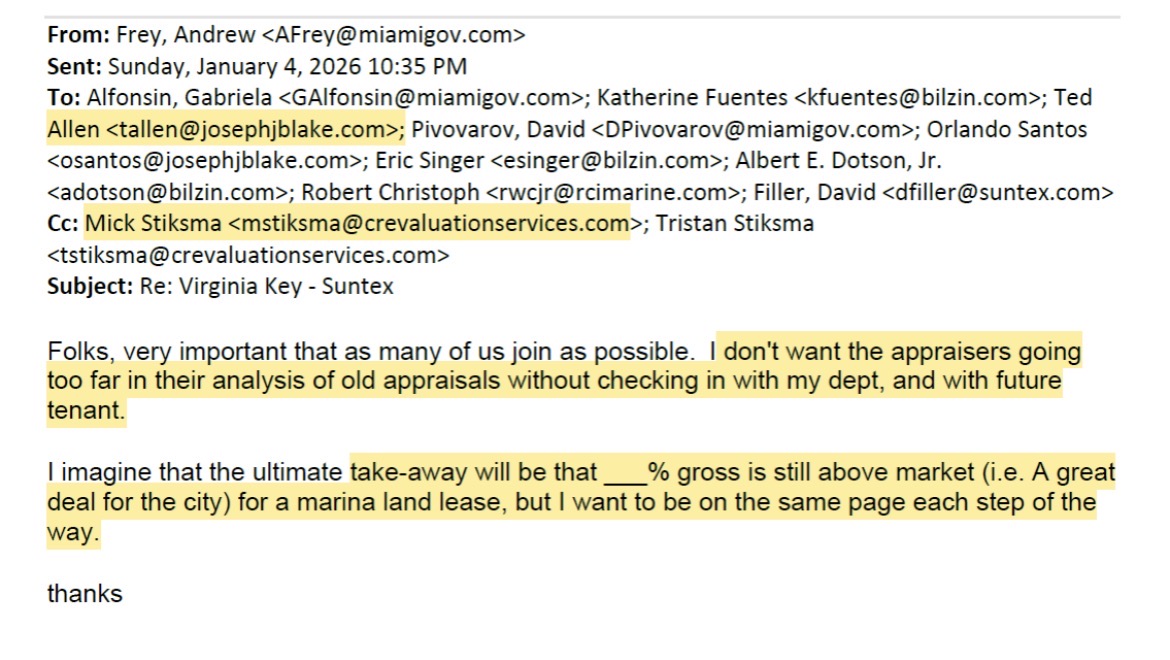
On the night of January 4, 2026 — before the kickoff call with the appraisers the next morning — Frey emailed the full group: City staff, both appraisal firms, Suntex, RCI, and the developer’s lawyers. He wrote: “I don’t want the appraisers going too far in their analysis of old appraisals without checking in with my dept, and with future tenant. I imagine that the ultimate take-away will be that ___% gross is still above market (i.e. A great deal for the city) for a marina land lease, but I want to be on the same page each step of the way.” (The percentage blank appears in the original.)
There it is, in one email: the City official overseeing the process (1) told the appraisers what he imagined the “ultimate take-away” would be — that the deal is “above market… A great deal for the city” — before the analysis was done; (2) instructed them not to go “too far” without checking in with his department and with the future tenant — the counterparty whose deal was being tested; and (3) asked to be “on the same page each step of the way.”
He meant it literally. The calendar shows a standing meeting series titled “VK Appraisals – Weekly Updates,” attended by City staff, both appraisal firms, Suntex, RCI, and Bilzin Sumberg — the appraisers and the appraised, together, every week.
The developer supplied the inputs
Appraisals are only as independent as their data.
Here, the comparable-lease data came from Suntex. On March 11, 2026, Suntex’s Eric Metz sent the appraisal group a package of lease comparables he had prepared: “Each lease is complicated so we’ve done our best to summarize it in an easily understandable format.” The party with the most to gain from the conclusion curated and summarized the market evidence for the people reaching it.
Then came the revenue assumptions. On March 20, appraiser Mick Stiksma asked a pointed question about the project’s 750 dry boat slips: how many are interior versus exterior? “The reason this is important,” he explained, “is because the Interior slips run about 30% higher in revenue than the exterior slips.” Absent an answer, he wrote, the appraisers would use a conservative “hybrid revenue rate.”
The answer came not from the City, and not from a lease term — but from the developer’s own lawyer, Eric Singer of Bilzin Sumberg: “you can assume all 750 are inside – that is the current plan.”
A plan. Their word. Not a contractual obligation — the City’s own lawyers had flagged, in an April 2025 memo, that the lease’s minimum-development definition contained “no reference to an automated boat storage and launch facility,” the very structure those interior slips would live in. So the appraisers were instructed to build their revenue model on the rosiest configuration, described only as a current intention, supplied by the party being appraised, overriding the appraiser’s own more conservative default. And because the deal’s payments to the City include a percentage of gross revenues, every inflated revenue assumption inflates the projected dollars this deal is advertised as delivering.
The developer reviewed the drafts
On March 27, 2026, the City’s lease manager transmitted the appraisals to Suntex and RCI with a simple instruction: “Please see attached draft appraisal reports for your review.” Eleven days later, the final was issued — and only after the comment window closed. The City’s April 7 email notes that the second appraiser “did not receive any further comments yesterday, per Friday’s call, and will be sending the final report today.”
Nothing was final until the developer had looked at it. Ask yourself: if an appraisal came in low, does anyone believe it would have survived that review unchanged?
This wasn’t a one-off — it’s how the whole deal has been handled
The appraisal thread is one strand in a longer pattern the records reveal. Voters have been told this deal is frozen by a court order — that nothing can be changed. Yet through 2025 and into 2026, well after that order, City staff and the developer were actively negotiating “business terms”: the affordable-housing contribution (Frey to the developer’s team: “Have you had conversations with electeds about appropriate housing contribution?”), reimbursement for the boat ramp the City built, phasing, and more — with some items steered into side agreements outside the lease itself. As late as January 27, 2026, the developer’s counsel wrote, “We are working on the revisions to the lease consistent with our earlier discussion,” while Frey pressed: “any final edits to lease? Ballot language? Need to finalize ASAP.” A frozen deal that was still being edited. The relationship was cozy enough for lunch plans in the Grove and warm sign-offs, and the coziness extended to the words voters will see in the booth. In June 2025, Frey suggested the group “review old ballot language, to see if can be re-used.” In January 2026 he asked the developer’s team whether there were “any tweaks from what was proposed years ago.” So the ballot language existed, in some form, years ago — and was being tweaked with the developer months before the public got its first look, just weeks ahead of the legal certification deadline. That matches what City Attorney George Wysong finally conceded on the record at the June 11 Commission meeting: “the court never reviewed that ballot language,” the ballot question was “negotiated,” and the City “demand[s] buy-in” from the developer on it.
The people who wrote the question, the people who will profit from the answer, and the people who produced the “fair market” paperwork were all on the same email threads, the same weekly calls, and the same page.
Call it what it is
Is this fraud? Fraud is a specific legal accusation — a knowing misrepresentation of material fact, made to induce reliance — and whether anyone’s conduct here meets that standard is a question for courts, under oath, with the full record. A pending lawsuit already alleges the appraisals are invalid under Charter Section 29-B and that they never valued the actual transaction being put to voters. We’ll let that process run.
But we don’t need a courtroom to say what these documents show on their face, in the participants’ own words. The purpose of the appraisals was to “confirm” a number both sides had agreed could not change. The expected conclusion — “above market… A great deal for the city” — was circulated by the City before the analysis was done. The appraisers were told to check in with the future tenant “each step of the way.” The market comparables and the pivotal revenue assumption came from the developer. The drafts went to the developer for review before they became final. Professional appraisal standards — the same USPAP rules every state-certified appraiser must certify compliance with — are built on independence, impartiality, and the absence of predetermined results. Measure this process against those words and draw your own conclusion.
Ours: this was not verification. It was choreography. A predetermined conclusion was dressed up in the costume of due diligence so that a Charter safeguard written to protect taxpayers could be checked off on paper — and so a talking point would be ready for “voters and reporters.”
Why it matters on November 3 Charter Section 29-B exists because 45 to 75 years is forever in waterfront economics. In 2021, City of Miami voters rejected a 75-year lease of this same public waterfront. This deal is back not because the public asked for it, but because litigation over a decade-old procurement pushed it back — and the machinery above was assembled to make stale terms look freshly validated.
A NO vote does not close the marinas, and it does not stop investment in Virginia Key. It stops this deal — and it tells City Hall that the next one must survive something this one was never subjected to: a genuinely independent test of fair value, conducted at arm’s length from the people who profit from the answer.
Vote NO on November 3.
————————————————————-
Sources
All records below were produced by the City of Miami in response to a public records request. Each item can be reconstructed by date, sender, and subject line.
1.	Email, Jan. 4, 2026, 10:35 p.m. — Andrew Frey (Director, City of Miami Dept. of Real Estate & Asset Management) to Gabriela Alfonsin and David Pivovarov (City); Katherine Fuentes, Eric Singer, and Albert E. Dotson, Jr. (Bilzin Sumberg, counsel to VKLLC); Robert Christoph (RCI); David Filler (Suntex); Ted Allen and Orlando Santos (Joseph J. Blake); cc Mick and Tristan Stiksma (CRE Valuation Services). Subject: “Re: Virginia Key - Suntex.” (“I imagine that the ultimate take-away will be that ___% gross is still above market (i.e. A great deal for the city)… I want to be on the same page each step of the way”; “without checking in with my dept, and with future tenant.”)

2.	Recurring meeting series, “VK Appraisals - Weekly Updates,” organized by Gabriela Alfonsin (first circulated Feb. 18, 2026) — attendees: City staff, both appraisal firms, Christoph, Filler, Singer.

3.	Email, Feb. 26, 2026, 9:27 a.m. — Frey to Alfonsin, Filler, Pivovarov; cc Christoph, Eric Metz (Suntex). Subject: “Re: Virginia Key Marina Pending Lease Terms (Matter ID 25-1653).” (“We need to wrap up these appraisals ASAP.”)

4.	Email, March 11, 2026, 10:56 a.m. — Frey to Filler, Alfonsin, Pivovarov; cc Christoph, Metz. Same subject. (“Commissioner doesn’t want to put on agenda until he is briefed… the main questions he will immediately get from voters and reporters… zero-margin timing situation to get on the ballot.”)

5.	Email, March 11, 2026, 3:20 p.m. — Eric Metz (Suntex) to Frey, Filler, Alfonsin, Pivovarov; cc Christoph. Same subject; attachment “2026.03.11_VKM_Lease.Comps_distro.pdf.” (“Each lease is complicated so we’ve done our best to summarize it in an easily understandable format.”)

6.	Emails, March 20, 2026, 2:42 p.m. and 4:32 p.m. — Mick Stiksma (CRE Valuation Services) to Singer, City staff, appraisers, Christoph, Filler; reply from Eric Singer (Bilzin Sumberg) to the same group. Subject: “RE: VK Appraisals - Weekly Updates.” (Interior slips “run about 30% higher in revenue”; otherwise “we will use a hybrid revenue rate”; “you can assume all 750 are inside – that is the current plan.”)

7.	Email, March 27, 2026, 1:13 p.m. — Alfonsin to Filler and Christoph; cc Frey, Pivovarov. Subject: “Appraisals VK LLC”; attachments “642530571A - Ground Lease - Virginia Key - FMV Rent - March 2026 WIP.pdf” and “25-403-02. Virginia Key Marina Draft.pdf.” (“Please see attached draft appraisal reports for your review.”)

8.	Email, April 7, 2026, 8:21 a.m. — Alfonsin to Filler, Christoph, Metz; cc Frey, Pivovarov. Subject: “RE: Appraisals VK LLC”; attachment “Virginia Key Marina Final.pdf.” (Final report; “The second appraiser, Mick, did not receive any further comments.”)

9.	Memo, “VKLLC Lease Pending Items” — Bilzin Sumberg point-by-point response, April 9, 2025 (document stamp MIAMI 12421780.2), circulated with Frey emails of April 10 and June 23, 2025. Item 12 (appraisals “required to confirm rent is consistent with FMV requirement set forth in Charter Section 29-B”; “We do not agree… Reopening a term as material as rent is also at odds with the court’s decision”); Item 2 (“no reference to an automated boat storage and launch facility”).

10.	Memo, “VKLLC Lease Pending Items” — annotated version with “Discussion with JL” / “Current Status” entries, Aug. 13, 2025 (document stamp MIAMI 12421780.3). (Rent/FMV “still an open issue”; housing contribution open.)

11.	Email chain, Feb. 27, 2025 – Aug. 19, 2025 — Frey, Jacqueline Lorenzo (Asst. City Attorney), Dotson, Filler, Christoph et al. Subject: “Virginia Key Marina Pending Lease Terms.” (Feb. 27, 2025: goal of ballot language “long before the July deadline”; April 21, 2025: “Maybe we meet for lunch in the Grove?”; June 23, 2025: “review old ballot language, to see if can be re-used”; Aug. 18, 2025: “Have you had conversations with electeds about appropriate housing contribution?”; boat-ramp CAPEX reimbursement discussions.)

12.	Emails, Jan. 6 and Jan. 27, 2026 — Frey to the VKLLC team (“any tweaks from what was proposed years ago?”; “Bobby, David, any final edits to lease? Ballot language? Need to finalize ASAP.”); reply from Singer, Jan. 27, 2026 (“We are working on the revisions to the lease consistent with our earlier discussion.”). Subject: “Virginia Key - Suntex.”

13.	Certified transcript, City of Miami Commission meeting, June 11, 2026 — City Attorney George Wysong: “the court never reviewed that ballot language”; the ballot question “is negotiated”; the City “demand[s] buy-in from the plaintiff.”

14.	Rickenbacker Marina, Inc., et al. v. City of Miami, et al., 11th Jud. Cir., Miami-Dade County (filed July 1, 2026) — Count II alleging invalid appraisals and absence of fair market value under Charter §29-B.